
The landscape of television has undergone a radical transformation over the last decade. Traditional broadcasting methods, such as satellite and cable, are increasingly being supplemented or replaced by a more flexible and efficient technology known as Internet Protocol Television (IPTV). This technology leverages the power of the internet to deliver high-quality video content directly to users, offering a level of control and variety that was previously unattainable.
What is iptv and how does it work
IPTV stands for Internet Protocol Television. Unlike traditional television, which broadcasts signals via radio waves, fiber-optic cables, or satellite beams, IPTV service delivers television content through a standard internet connection. It uses the same infrastructure that allows you to browse the web or send emails to transmit video data.
In an IPTV system, content is delivered in “packets” of data. This is fundamentally different from the “linear” broadcasting model where all programs are broadcasted simultaneously. With IPTV, the viewer only receives the specific stream they have requested, which optimizes bandwidth and allows for a more personalized user experience.
How IPTV Works Behind the Scenes
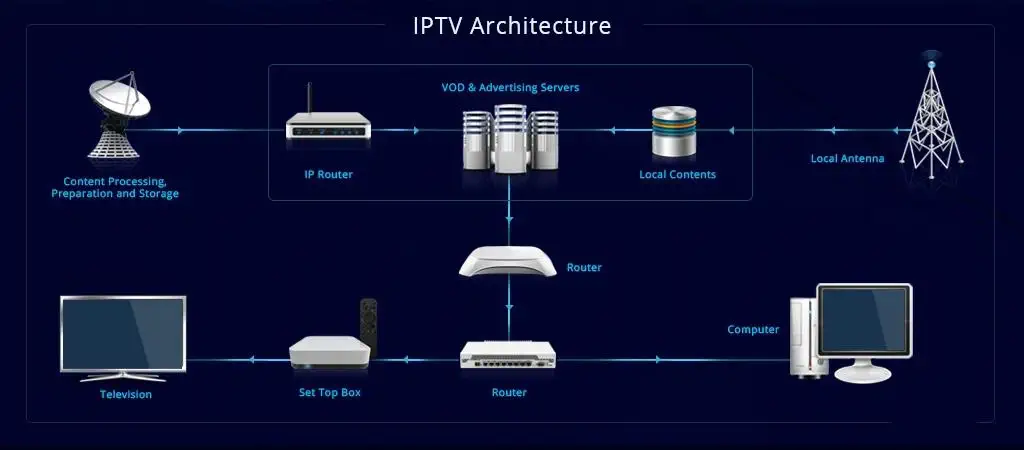
The technical framework of IPTV is complex but can be broken down into several key stages. To understand how a show travels from a server to your screen, one must look at the architecture of the network.
Content Acquisition and Encoding
Before a video can be streamed, it must be acquired from a source, such as a studio or a live broadcast feed. This raw video is then encoded into a digital format suitable for streaming. High-efficiency codecs are used to compress the video files without losing significant quality, ensuring they can travel smoothly over internet connections.
Servers and Storage
Once encoded, the content stored on central servers or Content Delivery Networks (CDNs). For Video on Demand (VOD) services, the files remain on the server until a user requests them. For live broadcasts, the stream processed in real-time and distributed across the network.
Data Packetization
When you select a program, the video is broken down into small IP packets. These packets are labeled with their destination and sent across the internet. When they reach your device, they are reassembled in the correct order to provide a seamless viewing experience.
The Role of the Set-Top Box
To decode these IP packets back into a format your television can display, an intermediary device often required. This could be a specialized set-top box, a smart TV application, or a software player on a computer or smartphone. These devices act as the final translator in the IPTV chain.
The Three Main Formats of IPTV
IPTV not a singular service; it manifests in several different formats depending on how the content is delivered and consumed.
1. Video on Demand (VOD)
VOD is perhaps the most popular form of IPTV. It allows users to browse a library of movies or shows and watch them whenever they choose. There is no schedule to follow; the content begins as soon as the user hits “play.”
2. Time-Shifted Media
This format allows users to watch previously aired broadcasts. It includes “catch-up TV,” where you can watch a show that aired hours or days ago, and “start-over TV,” which allows you to restart a live program from the beginning if you tuned in late.
3. Live IPTV
This is similar to traditional television broadcasting but delivered via the internet. It used primarily for live sporting events, news, and award ceremonies, where watching in real-time is essential.
Benefits of Transitioning to IPTV
The move toward IPTV driven by several advantages that traditional broadcasting cannot match.
- Multi-Device Compatibility: IPTV not limited to the living room television. Users can access their favorite content on smartphones, tablets, laptops, and smart TVs, provided they have an internet connection.
- Interactivity: Because IPTV is two-way communication, it allows for interactive features such as integrated messaging, program recording, and personalized recommendations based on viewing history.
- High Definition and 4K Support: Internet protocols are highly efficient at handling large amounts of data, making it easier for providers to deliver Ultra-HD content compared to restricted satellite bandwidths.
- Cost Efficiency: For many users, IPTV offers a more customizable experience where they can choose specific packages or services that fit their needs, often at a more competitive price point than traditional cable bundles.
The Infrastructure Requirements
To enjoy a high-quality IPTV experience, the underlying infrastructure is critical. The most important factor is bandwidth. Since IPTV relies entirely on your internet connection, a stable and high-speed broadband service is necessary to avoid buffering or low-resolution playback.
Most modern IPTV services recommend a minimum speed of 10 Mbps for standard definition and at least 25 Mbps for 4K streaming. As fiber-optic internet becomes more common globally, the reliability and quality of IPTV services continue to improve, making “buffering” a thing of the past for most users.
The Future of Digital Broadcasting
As internet speeds increase and 5G technology becomes more widespread, IPTV is set to become the standard for all television consumption. The transition from hardware-based broadcasting (dishes and cables) to software-based streaming (apps and IP) allows for rapid innovation.
Future developments in IPTV are expected to include more immersive experiences, such as virtual reality integration and more advanced artificial intelligence to help users discover content. The flexibility of the protocol ensures that as the internet evolves, television will evolve alongside it.
In summary, IPTV represents the marriage of traditional media and modern internet technology. By offering flexibility, high quality, and a vast array of content, it has redefined what it means to “watch TV” in the 21st century.